



What Are Financial Statements?
Financial Statements are official financial records that show the financial position and performance of a company.
They are typically prepared annually and may include:
- Statement of Financial Position
- Profit & Loss Statement
- Cash Flow Statement
- Notes to the Financial Statements
For companies that require audits, these documents must also be audited by a licensed auditor before submission to SSM.
Who Needs to Prepare Financial Statements?
Financial Statements are generally required for:
- Sdn Bhd companies in Malaysia
- Active companies with business transactions
- Companies required to comply under the Companies Act 2016
Certain companies may qualify for audit exemption based on SSM criteria.
Filing Requirement
| Requirement | Timeline |
| Prepare Financial Statements | Within 6 months from financial year end (FYE) |
| Circulate Financial Statements to shareholders | Within 6 months from FYE |
| Lodge Financial Statements with SSM | Within 30 days from circulation date |
Example
If your company’s Financial Year End (FYE) is:
31 December 2025
The Financial Statements should generally be:
- Prepared by: 30 June 2026
- Lodged with SSM within 30 days after circulation to shareholders
What Information Is Included in Financial Statements?
Financial Statements typically include:
- Company assets and liabilities
- Revenue and expenses
- Profit or loss
- Share capital information
- Director’s report
- Auditor’s report (if applicable)
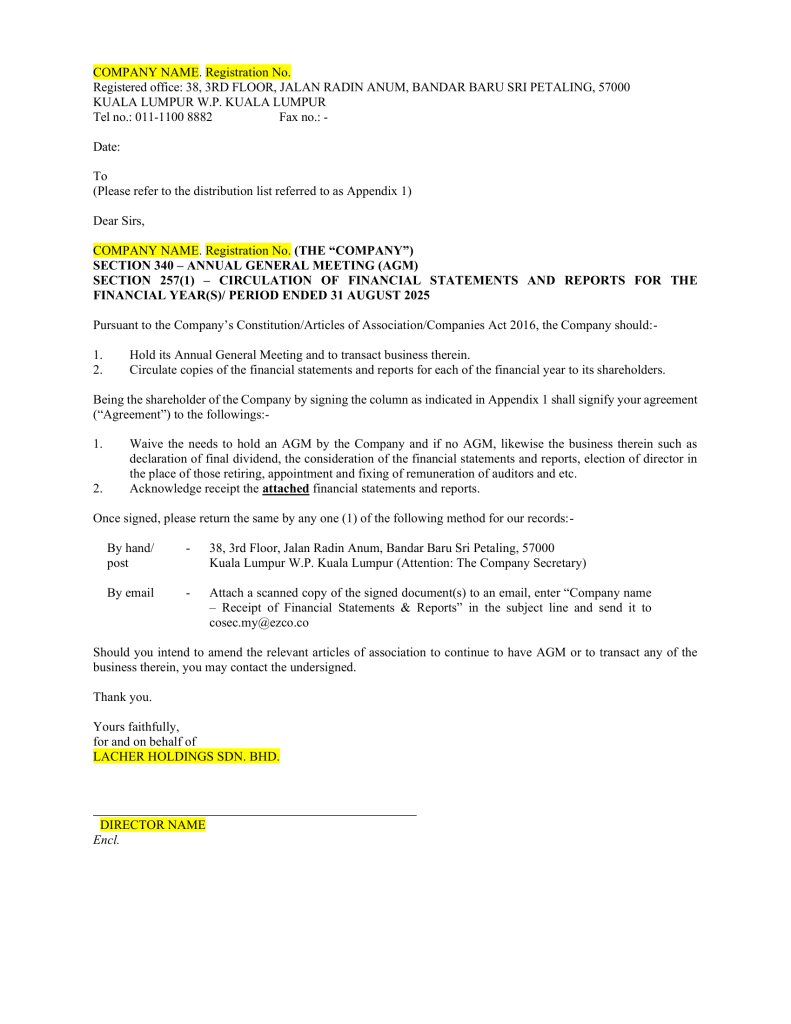
Sample of Financial Statements
Consequences of Failing to Lodge Financial Statements
Failure to prepare or lodge Financial Statements may result in penalties and enforcement action under the Companies Act 2016.
Possible Penalties & Consequences
| Offence | Possible Penalty / Consequence |
| Failure to lodge Financial Statements within required timeline | Fine of up to RM500,000 |
| Continuing offence after conviction | Additional fine of up to RM1,000 per day |
| Failure to comply with Companies Act 2016 | Enforcement action against directors |
| Prolonged non-compliance | Risk of company being flagged or struck off |
Important Reminder
Even if:
- the company has low activity
- the business generated minimal revenue
- operations were temporarily inactive
Financial reporting obligations may still apply.
Dormant companies should assess whether they qualify for audit exemption rather than assuming automatic exemption.
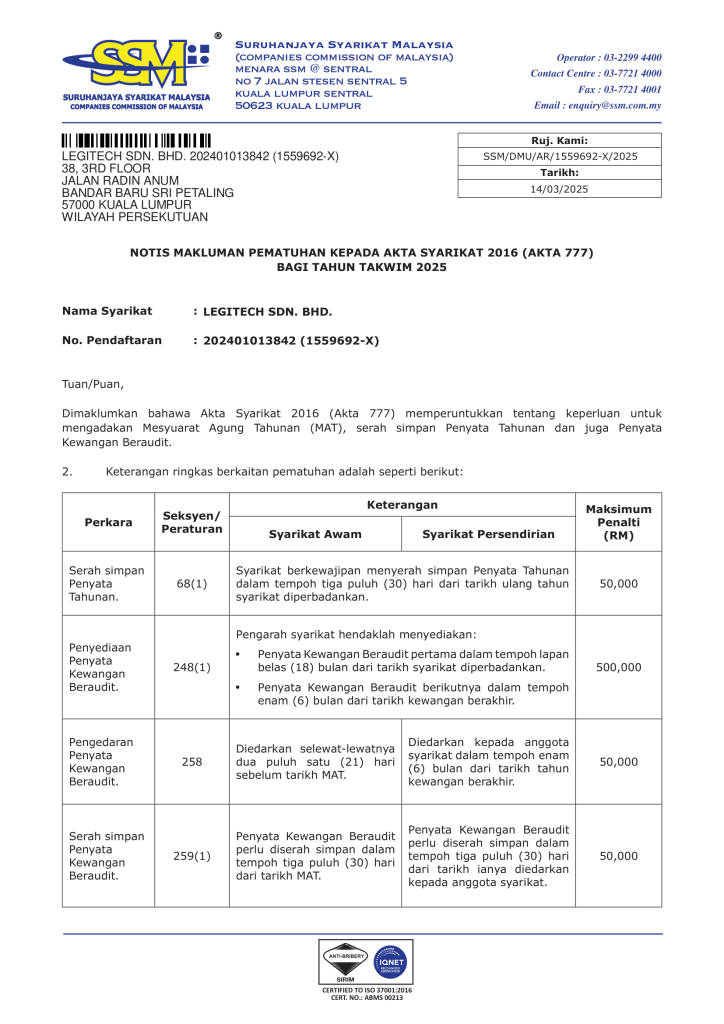
Sample Penalty / Compound Notice
Common Mistakes
- Assuming bookkeeping alone is sufficient
- Missing financial year end deadlines
- Delaying audit preparation until the last minute
- Confusing tax filing with Financial Statement lodgement
- Assuming dormant companies are automatically exempt from audit requirements
How Altomate Can Help
Preparing Financial Statements can become stressful when bookkeeping records are incomplete, deadlines are missed, or audit requirements are unclear.
Many companies only realise compliance issues when auditors, tax agents, or SSM filing deadlines are already approaching.
Altomate helps simplify the process through:
- Bookkeeping support
- Financial Statement preparation
- Coordination with auditors
- Compliance deadline reminders
- Financial record organisation
- SSM lodgement assistance
- Ongoing compliance support
This helps businesses reduce the risk of:
- Late lodgement penalties
- Incomplete financial records
- Audit delays
- Compliance issues with SSM
- Last-minute filing complications
Need Assistance?
Contact Altomate on WhatsApp for assistance with:
- Financial Statement preparation
- Audit coordination
- SSM compliance support
- Bookkeeping services
- Overdue lodgements
- Ongoing financial compliance management


